

There’s a job I didn’t apply for.
I was an Assistant Principal in a large general FE college. A Vice Principal role came up, and I was asked to go for it. Not a hint dropped in a corridor, not a vague you should think about your next step. An actual ask, from someone with the power to appoint me, and more than once.
I said no.
The reason I gave was that I couldn’t do my fair share of the after-hours work. I was a single parent. My two were 14 and 17, still at home, and I could not see how I would give a job at that level what it needed and still be what they needed. So I stayed where I was.
I’ve thought about that decision a lot since. I think about it every time the workforce data comes out.
Four releases and a flat line
Here’s what the latest release says. Women are 65% of the FE workforce. 62% of managers are women. Only 54% of leaders are.
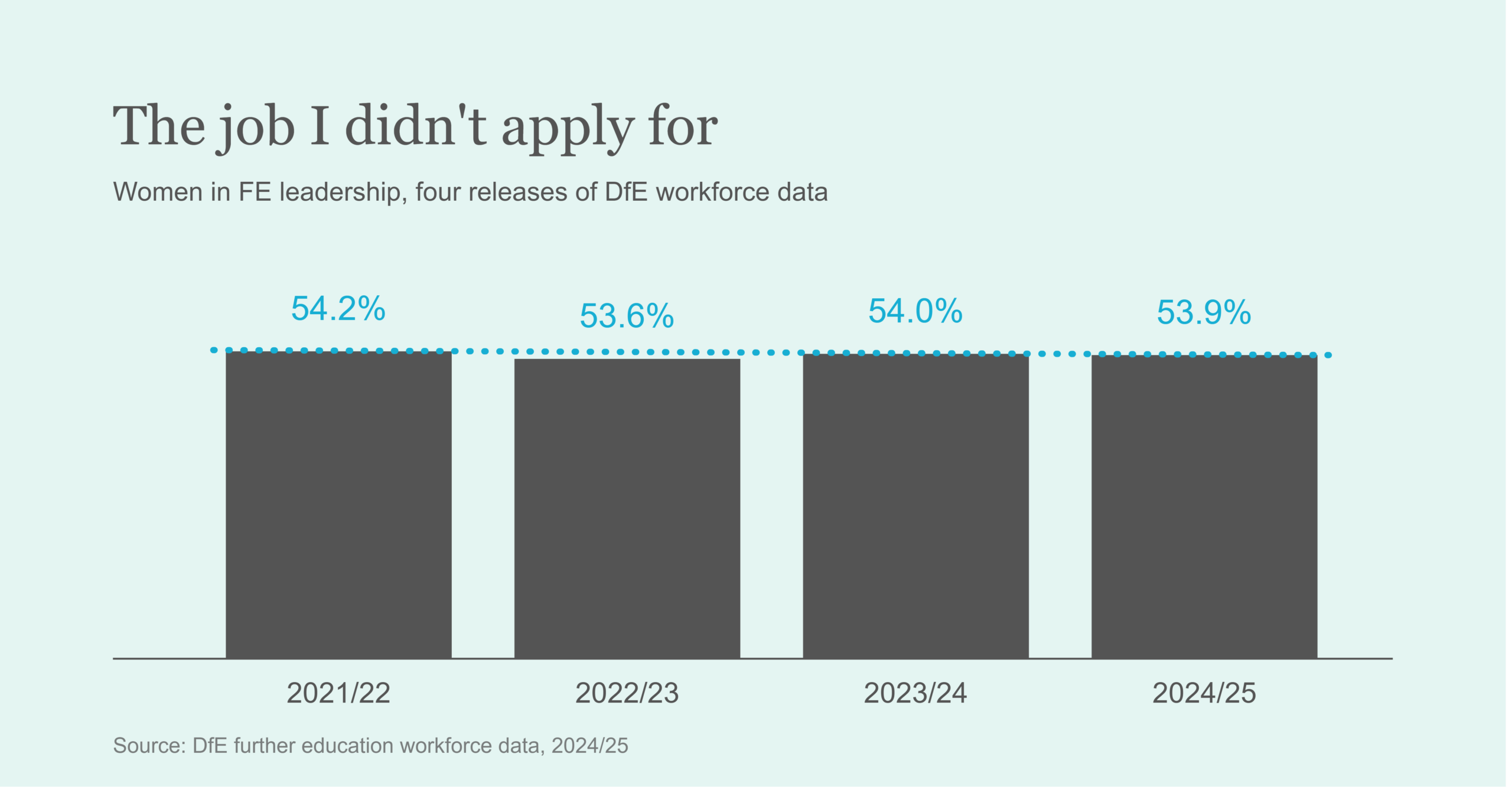
And here’s the bit that stopped me. Look at the share of women in FE leadership across the last four releases. 2021/22, 54.2%. 2022/23, 53.6%. 2023/24, 54.0%. 2024/25, 53.9%.*
Four releases. A flat line sitting just above half.
The longer arc did move, up from 40% in 2017, and people in the sector are quick to point that out. Fair enough, it’s true. But the progress happened and then it stopped, and we’ve now had four years of nothing while a lot of people have been working quite hard on it.
So the question I keep coming back to isn’t whether there’s a problem. It’s where the problem actually sits.
The drop happens at one step
Because the drop doesn’t happen everywhere. Women aren’t disappearing at the bottom of the sector. They’re 65% of it. They’re not disappearing in middle management either, they’re 62% of managers. The fall happens at one specific step, manager to senior leader.
That’s not a general disadvantage spread evenly across a career. That’s a fingerprint. Something is happening at one point on the ladder and not the others.
So what’s different about that step?
The step where the job stops being containable
I’d argue it’s the step where the job stops being containable.
You can do a Head of Department job around a family. It’s hard, and it’s more hours than anyone admits, but you know roughly what the year looks like. You know when the pinch points are. Open evenings and results days are in the calendar months ahead, and you can plan the rest of your life around them.
Senior leadership doesn’t have those edges. Governors’ meetings in the evening. Events you’re expected to be at because you’re the visible face of the college. Things that come up at four o’clock on a Tuesday and have to be dealt with by six. The job expands to fill whatever is available, and if what’s available is limited because someone at home needs you, then the job and your life are in direct competition in a way they weren’t before.
And here’s the thing about who’s standing at that particular step. It’s overwhelmingly women in their late thirties and forties, which is exactly when caring responsibilities are heaviest. Young children, or teenagers, or a parent who’s started needing hospital appointments three times a week. Often more than one of those at once.
So the sector’s most demanding step and its heaviest caring years land at the same moment. That’s not a coincidence, and it isn’t a coincidence that the line hasn’t moved.
But it wasn’t confidence
Now, the explanation the sector usually reaches for is confidence. Women don’t put themselves forward. Women don’t apply unless they tick every box. Women need more encouragement, more sponsorship, more visible role models.
There’s something in that. I’ve sat with enough women looking at a person spec and counting only the boxes they haven’t ticked to know it’s real.
But it doesn’t explain my no.
I was asked. By the person with the power to appoint me, more than once. I had four and a half years as an AP behind me, I’d been an Ofsted inspector, I’d built provision from nothing and made it work. Nobody needed to sponsor me or spot my potential or encourage me to lean in. It had all already happened.
I still said no, and the reason had nothing to do with whether I thought I could do the job. I knew I could do the job. I couldn’t see how to do the job and be the only adult in my house.
If encouragement were the fix, I’d have gone for it.
And my children were 14 and 17. Nearly grown. If a single parent of near adults, already at AP level, already invited, still couldn’t see a route to VP, then I’d gently suggest the problem isn’t sitting inside the women. It’s sitting in the shape of the job.
What I can’t prove
I want to be honest about what I can and can’t evidence here. One decision of mine isn’t a study. I’ve had two comments on LinkedIn recently that said something close to the same thing, one from a woman who couldn’t take on the late nights and looked around and saw nobody like her who needed flexibility, another who said she was already exhausted between work and home and had no room for more. I’ve also had many conversations with women not in FE, who feel the same way – they can’t see how they can fit both in. That’s not a dataset either. It’s people who happened to be honest in a comments box or a conversation.
I also know it isn’t the whole picture, because plenty of women do step up, and some of them tell a different story entirely. The late Suzanne Duncan, when she was Principal at East Durham College, once told me that becoming Principal gave her more flexibility for her family than she’d ever had before. She could carve time out of her week for the things that mattered. That has stayed with me for years, because it’s the exact opposite of what everyone assumes, and it came from someone at the very top.
Which raises an uncomfortable possibility. What if the job at that level is more flexible than it looks from below, and the problem is partly that nobody standing at the bottom of the step can see it?
I don’t know. I genuinely don’t. But I know what I could see from where I was standing, and I know what I decided.
If you run a college
Here’s what I’d say to anyone who runs a college and wants their next senior team to look different. The women you’re trying to promote are not lacking ambition and they are not lacking encouragement. Some of them have done the sums on what your senior roles appear to require and concluded it doesn’t fit. If your evening commitments are genuinely non-negotiable, say so honestly and accept the consequence. If they’re not, if there’s more give in those roles than the folklore suggests, then somebody needs to say that out loud, because right now the assumption is doing the filtering for you. I wrote an article about this very thing.
If you’re the one deciding
And here’s what I’d say to the woman looking at the AP or VP role and quietly deciding against it.
I made that decision. I’m not going to tell you it was wrong, because I don’t know your situation and it might well have been right for me at the time.
But I made it on assumptions I never tested. I never asked what the evening commitment actually was. I never asked whether it could be shared differently, or done less often, or whether anyone had ever negotiated it. I decided what the job required, and then I acted on my own decision as if it were a fact.
Four years of flat data suggests I’m not the only one.
*DfE further education workforce data 2024/25, published 14 May 2026, at https://explore-education-statistics.service.gov.uk/find-statistics/further-education-workforce/2024-25.